
-
Save
Tom Stevens’ bio on tombot.com cites his 30 plus years in various executive levels at high tech companies and being someone who “embarrasses his kids often with his dance moves.”
No stranger to the ambitious and unconventional, Stevens is currently taking a traditional axiom of inventing and flipping it on its ear.
“Necessity is the mother of invention” is now “Mother was the necessity of invention.”
A global challenge
It was 2011. When Stevens’ prior startup, one of the world’s largest litigation automation companies, was acquired, he suddenly had the financial freedom to ponder many new entrepreneurial challenges.
That same year, his mother, Nancy, was diagnosed with Alzheimer’s dementia. As is the case with millions of other adult children around the world, Stevens had to make an increasing number of decisions on a parent’s behalf.
His mother, plagued with loneliness and depression, had lost the ability to care for herself. Worse, she had trained her treasured Goldendoodle puppy, Golden Bear, to be aggressive toward her caregiver.
The time had come to take her dog away from her, for her own safety.
“She was very unhappy with me,” Stevens said in a recent Zoom call. “I looked around for substitutes for live animal companions. She didn’t like anything that I brought home, and I realized then that there was a very large gap in the market.”
This was not going to be a quick fix. “Just out of the desire to salvage my relationship with her, I embarked on what became a multi year research and education journey culminating with a master’s degree from Stanford University. And along the way, I learned my mom’s story is shared by over 300 million seniors with dementia or pre dementia mild cognitive impairment. About half the planet, about 1 billion of 2 billion households, do not keep live animals or pets for reasons including health adversity, cost, burden of care and living restrictions.”
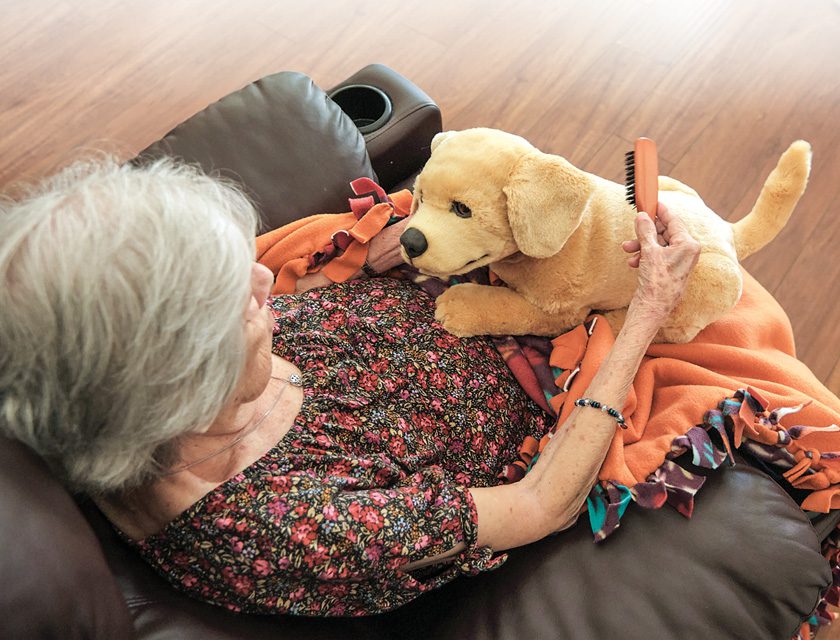
Stevens’ desire to find a lasting product market fit to address this void spawned the idea for his company, Santa Clarita, California based Tombot, in 2017. It has spent years of painstaking research and development perfecting a lifelike robotic dog named Jennie that is designed to be a psychological and emotional aid for Alzheimer’s and dementia patients or anyone with developmental challenges.
Medications alternative
At first glance, Jennie may look like a toy. Jennie is not a toy.
“Our product, first and foremost, is a health care device,” Stevens said while petting Jennie, which responded with the realistic movements of a dog sitting comfortably with its owner. “We’re a consumer health tech product, like an Apple smartwatch and a medical device and FDA medical device.”
He said the company’s primary intended user is a senior with dementia. Research revealed they suffer from behavioral and psychological symptoms that include loneliness, depression, anxiety and delirium. His mother often suffered from hallucinations and violent anger.
“To manage these symptoms, doctors historically relied upon psychotropic medications. These are anti anxiety, antidepressant, antipsychotic medications. And while you or I might tolerate those medications without a problem, they’re particularly hard on the elderly, so much so that the Centers for Medicare and Medicaid Services now prohibit them for use in long term care under most circumstances.”
Objects such as humanlike baby dolls and stuffed animals can be therapeutic for some people, especially children. “But most seniors are like my mother, and they don’t care for baby dolls and stuffed animals. Research on robotic animals shows they significantly outperform those traditional objects and have the added benefit of reducing the need for pain medications.”
Building on a solution
Robots as therapy is not a new concept. Robots as practical, affordable therapy is an ongoing challenge, albeit with promise.
This market space began in 2003 in Japan with the PARO Therapeutic Robot, an interactive robot resembling a baby harp seal that is now in its eighth generation of design.
“It’s a good robot,” Stevens said. “But it costs over 6000 dollars, and most senior care facilities can’t afford one, let alone individuals like my mother who need one for themselves in order to form that emotional home.
“So, we didn’t set out to develop a robotic puppy. We set out to develop a better emotional attachment object. And we studied with over 700 seniors with dementia, conducted multiple rounds of formal studies, and developed multiple generations of high fidelity prototypes.
“We learned a great deal through those studies. But the biggest takeaways were realism, the appearance, the texture and most important, the behaviors.” The robot dog has nine motors to control its movements. Its many sensors respond to voice commands and detect how softly or strongly people are touching it.
“We teamed up with the Jim Henson Creature Shop and with their help doing our artistic design, we’re making what we believe to be the world’s most realistic robotic animals, scientifically designed to stimulate emotional attachment,” Stevens said. “And once in place, we become a unique platform for monitoring seniors for safety and health.”
2 main criteria met
An emphasis on research is a hallmark of Stevens’ long track record in product development. Inventors of all kinds can learn from the two main considerations in any entrepreneurial project he is considering, which in the case of Tombot neatly checked the boxes after comprehensive research.
“First is product market fit, the ability to solve a serious customer problem in a manner they love. What does it take to actually cause the customer to fall in love with the product and maintain that emotional connection? You can use data, observational data, sensory data and measure whether A is better than B.
“Second is achieving that with minimum viable product. We could create a 100000 dollar robot that everybody would love, and nobody would buy. My philosophical approach on achieving product market fit is to start with a lesser product and then iterate until you get there.”
Stevens is confident that Tombot is a strong fit for both factors for seniors with dementia. But these aren’t the only people who can be helped.
“There are children with Level 2 and Level 3 autism. There are others with intellectual and developmental disabilities. There are people who are otherwise healthy who live alone in social isolation and severe loneliness.
“And so we’ll continue to do research and continue to advance the studies and bring out different models of technology.”
Good tech timing
Without exponential advances in technology, Stevens’ essential criteria for minimum viable product through widespread affordability could not have been met.
“Before the advent of the smartphone, there’s no chance there could have been a formula for that. The smartphone did a couple of different things.
“First, it created a whole industry of sensors. And those sensors, where they would have had to have invented your own back before the iPhone came along, there are now many different types of sensors that are really inexpensive, almost free in many cases. So from a pure bill of materials standpoint, we’re able to license a lot of sensors and sensor technology without driving up our total costs.”
He said the next byproduct of the advent of the smartphone was the makerspace era and 3D printing.
“If we had to build from scratch every part or do injection molding for every part as we were iterating through the designs, it would have taken tens of millions of dollars and much longer than it has for us to get something that is not as good,” he said. “But because of 3D printing, we can rapidly prototype.
“The studies that we did, with the help of Jim Henson’s Creature Shop, allowed us to create new versions fairly quickly. Pieces were very fragile. They’re not going to pass any safety certifications. But we can at least get them looking or behaving the way we need them to much faster.”
Hot worldwide demand
The company’s contract manufacturing partner is in Hong Kong, but Stevens said there will also be U.S. manufacturing. The product’s lofty standards for quality and realism, along with the need to meet stringent safety requirements, have resulted in ever progressing iterations and shifting timetables.
A big picture motivation for getting everything right: Stevens and his team anticipate their patent pending intellectual property will be protected by FDA regulation as a medical device, with the goal of eventually qualifying for public and private health insurance reimbursements.
Safety guidelines can be strict for a product meant for people with lesser mental and physical capacities. Meeting child safety certifications has been particularly challenging because nearby children will be attracted to the dog’s fur.
Stevens’ latest ETA for shipping the product to customers is summer 2026, after hospital clinical studies begin in spring. Aided by worldwide media coverage and funding approaching 15 million dollars, Tombot has more than 18000 pre order and waitlist customers from 116 countries.
“This number includes more than 500 business to business customers, including hospital health systems, assisted living and memory care communities, skilled nursing facilities and more. We estimate our total backlog of robots to be more than 100000.”
Potential customers visiting the product website should know that the pictures of Jennie may not be fully up to date due to constant refinements.
Tombot will follow its successful appearance at this year’s Consumer Electronics Show with another appearance in January.
Stevens has appeared on panels at CES for several years. “I’ve spoken about robots for good, AI for good and so forth. So just showing up with a prototype and talking about these things brought a lot of media attention, including Time magazine selecting us as a best invention.”
Nancy Stevens would doubtless be thrilled. She died in 2018 after being “our first prototype tester,” and the inspiration for a product now eagerly awaited around the world.