
-
Save
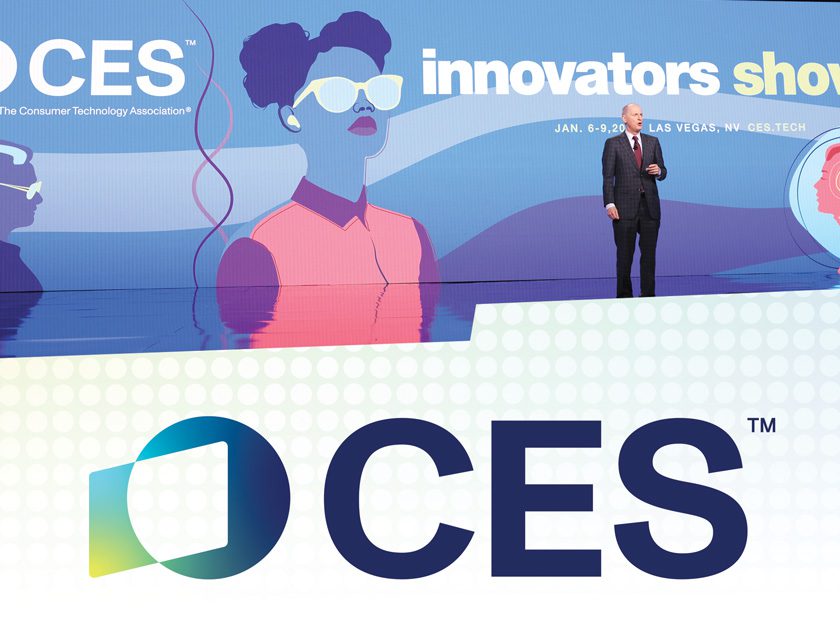
Three large-type numbers on the Consumer Electronics Show website’s homepage provide an indication of the annual tech smorgasbord’s massive scale and influence:
• 148,000-plus attendees at this year’s show, January 6-9.
• More than 41,000 exhibitors.
• Over 6,900 global media, content creators and industry analysts.
But numbers not prominently displayed provide even greater context as to the occasion’s vastness of people and walking real estate.
There are “only” about 150,000 hotel rooms in Las Vegas—the most for any U.S. city—to accommodate those 148k people. The exhibit space for the event at the Las Vegas Convention Center totals 2.5 million net square feet; the Taj Mahal occupies 1,832,880 square feet.
This confluence of factors spawns a steady sensory buzz produced by professionally presented products with pragmatic possibilities, housed for the better part of a week in an expansive cocoon of wildly escalating science and innovation where the room temperature reflects a future that is but a fleeting instant on the way to something else—hopefully better.
Here are insider insights and experiences of industry professionals who have been there, lived that. —Reid Creager
This Year’s Takeaway:
AI Is Ubiquitous, Organic
By Adam Holden-Bache
After visiting thousands of exhibitor booths at CES 2026, a few things became clear. The era of flashy gadgets that demand constant attention is fading, and this was the year artificial intelligence stopped feeling experimental and started feeling infrastructural.
Across categories, AI showed up less as a headline feature and more as an invisible layer. Many products paired thoughtful hardware with complementary AI that stayed out of the way.
Technical complexity was hidden behind clean interfaces, with a clear focus on making daily life easier rather than more complicated. In many cases, technology adapted to people, not the other way around.
AI was everywhere and everything at the show, finally moving from buzzword to baseline. It was embedded across nearly every category—often quietly—powering personalization, automation and predictive behavior without demanding user attention.
The latest trends regarding AI’s impacts in these categories:
Wearables continued their evolution beyond simple tracking. Smart glasses leaned heavily into AI voice interfaces and real-time translation. Smart rings added gesture controls, while earbuds and watches focused on deeper health insights, including stress, recovery and long-term wellness metrics.
The smart home category showed clear signs of maturity. Core appliances such as smart locks, coffee makers and vacuums became more affordable and more reliable. The kitchen, in particular, is now almost fully digitized, with internet-connected versions of nearly every appliance becoming the norm rather than the novelty.
Robotics split into two clear directions. The first was practical helper robots, including more capable cleaning robots and early household assistants that handle tasks like organizing, monitoring and light chores. While still limited in scope, these systems showed meaningful progress albeit with plenty of room for improvement.
The second direction was companionship. Emotional support robots ranged from small tabletop companions to pet-like devices and even humanoid robots capable of surprisingly natural interaction. These products focused less on utility and more on presence, comfort and emotional engagement.
Health technology stood out for its move toward personalization and clinical grade diagnostics integrated into everyday life. AI-powered body scanning mirrors analyzed heart health, weight and metabolic markers in seconds. Exoskeletons designed for knee and leg support demonstrated significant gains, offering up to a 50 percent boost in leg power while offloading substantial physical strain.
CES 2026 was unquestionably dominated by AI. At times it felt forced, but in many products it was thoughtfully integrated and genuinely useful.
AI no longer feels optional or speculative. It is becoming an expected layer of modern technology.
However, what stood out most was the shift in tone.
In a show filled with innovation, restraint may have been the most important signal. Consumer tech does not appear to be getting louder, faster or more attention seeking; it is becoming quieter, more deliberate, more human focused.
If CES 2026 proved anything, it is that meaningful innovation speaks through usefulness rather than volume. The future of innovation lies in subtlety, not spectacle.
Out of the Fire:
Humane, Healthful Tech
By Alyson Dutch
Returning to CES this year was bittersweet for me. Just as I arrived last year, the Palisades firestorm—90-mph winds with 2,500-degree flames—broke out in southern California.
It took out 13,000 homes, one of which was mine.
It was surreal returning on the first anniversary of so much shock and grief, but it felt good to be busy and not wallowing. I wore a pair of shoes gifted to me from a fabulous brand called Soludos that had rainbows and ocean waves on them. They kept my spirits high as I ambled about.
This year, CES was all about AI-informed robots: robots for seniors, robots as pets, robot hand sensors that mimic signals from three parts of our brain.
Until now, robot pinchers have picked up auto parts to move them down assembly lines. By today’s standards, that is troglodyte behavior. To be helpful in new applications, like housemates or nurses, they need to know how much pressure it takes to pick up and wash a soapy wine glass versus delivering a 20-pound Amazon box from the front porch or serving up tiny pills alongside a cup of tea.
Marketed as the “first force/tactile feedback teleoperation data acquisition system” by Daimon Electronics, the DM-EXton2 replicates human movements 1:1 with impeccable precision while performing ultra-fine manipulation tasks, like holding a piece of tissue paper between two “hands.” These brilliant engineers mapped all the brain signals that happen between our eyes, fingers and other parts of our body to retain balance and movement while using our hands—things we take for granted every moment.
My favorite was a company called OlloBot. A full line of fuzzy and fun cyber-pets rolled and lolled about on chassis dressed in adorable, animal-like fur, with flippers and tails—all on a vacuum cleaner-canister-sized wheeled body. Some had purple, fuzzy necks that stretched up with curiosity and expressive, mini-iPad-sized monitor faces.
They were developed by a young woman who wanted to bring warmth to the robot world; she is a rare bird among the male-dominated industry. She chose America to launch her furry friends when she learned that 71 percent of American households have pets and spend an average of $1,700 a year on them due to being incredibly emotionally invested in our four-leggeds and others.
Another, called ElliQ, was named an “elder sidekick” by Fast Company magazine. This expressive and friendly dome-shaped, table-type lamp pivoted, spoke and flashed, floating on a seemingly detached base. It was charming.
Developed as a health companion, is it a medication reminder and something to talk to. Clinical trials showed that seniors living alone with ElliQ were feeling a lot better about life.
All the health tech was mind-blowing. Of note was female-led MicroLumix Biosciences, which found that viruses are most prevalent on elevator buttons. MicroLumix conducted a study that showed an innocuous bug deposited on a lobby floor elevator push button had spread to every single hospital room upstairs in only six hours.
Wow!
The company’s invention, called GermPass, was a panel that could be placed over existing elevator banks with UVC light doors that cleansed the buttons before and after every use. I will never use my finger on an elevator button again. Hello, elbows!
A very serious health tech company, Insulet, was doing a great job of making its diabetes monitoring and insulin delivery wearable more approachable for children. Its collaboration with Marvel resulted in the world’s first diabetic superhero.
Given that an estimated 1.8 million children and adolescents under 20 are living with Type 1 diabetes, this pairing was beyond brilliant. Even more interesting was the fact that this monitor actually delivers insulin—an innovation informed by two recent global conflicts, one in Gaza and the other in Ukraine.
During these wars, it was discovered that insulin does not have to be refrigerated and can last three days. Who knew? That’s a resourceful inspiration.
CES has thankfully shrunk since Covid. Before then, the event was spread out across 21 locations throughout Vegas. It was untenable.
This time, most of the consumer products were at the Venetian, the business-to-business and OEM stuff at the Convention Center. This year, the show added a marketing pavilion at the Aria.
Among the land of my fellow marketing gurus at the glitzy and youthful-vibed Aria, my favorite there was the global advertising agency HAVAS. It identified a new consumer segment and created a proprietary technology to reach them called the Neuroverse.
HAVAS’ research found that among Gen Z-ers (20 percent of Americans ages 13-28, 69 million digital natives), 1 in 5 identifies as neurodiverse. For better or worse, this means they are dealing with issues ranging from ADHD to autism.
This segment is the largest buyers of trendy apparel, tech and digital services. I do appreciate profiling for the sake of marketing.
Otherwise, another CES in the books with some new relationships and breakthrough insights. Best of all, I have a refreshed feeling about Vegas that does not include fire.
Show and Excel:
An Exhibitor’s Survival Guide
By Jeremy Losaw
Although the latest TV technologies from the large tech firms take most of the national news headlines at CES, the invitation-only show is valuable for startups and small companies, too. It can be a key moment to show off an awesome prototype, get feedback from industry pros and find investment or manufacturing partners.
Exhibiting at CES is exhausting and stressful, and yet there is nothing quite like it.
For a few intense days, you’re plugged directly into the current of innovation. You see how people react to your idea in real time, make key connections to move your business forward and feel the electricity of the consumer electronics industry.
However, it can be a big lift to exhibit at CES, even for small companies. It is easy to get sucked into the glamor of being in the exhibition hall—and what is less obvious is how much planning, endurance, improvisation and physical effort it takes to make that moment happen.
Exhibiting isn’t just about showing a product. It’s about surviving a temporary, high-voltage environment where every decision matters.
Booth blueprinting
The first challenge starts months before you arrive: You have to figure out what you are going to do for a booth.
For many early-stage startups, areas like Eureka Park are the best entry point. They’re designed for young companies and first-time exhibitors. They also come with constraints.
The booths are identical 10-by-10 footprints. Everyone gets the same white walls and a podium. The rest is up to you to create the experience you want for your product—and set yourself apart from the rest.
The complexity of what you will do depends on your budget. At minimum, plan a banner with clear graphics and a clean way to demonstrate your prototype.
Some companies hire professional firms to design complex experiences. This was the case when I helped exhibit the Glo smart doorbell product. We even went so far as to build a huge version of the doorbell to draw people to the booth.
Getting there
Las Vegas can be a hike for many of us, with the added challenge of ensuring all your materials and prototypes make it there safely.
If the booth is being professionally done, the company will likely have well-established connections with freight carriers that can deliver the materials directly to the show. However, if you are building elements yourself, you will have to work through shipping them with retail carriers or palletizing and working out the freight yourself.
There is also the issue of how to transport your potentially fragile prototypes. Be sure you comply with airline regulations for batteries and safety, and that they are packaged carefully enough to survive any abuse from baggage handlers.
The first time I went to CES, I had to bring a full gas stove top to the show to exhibit a kitchen product. It was heavy and bulky—and took some extra smiles and explanation with the gate agents in order to get it on the plane.
Plan your setup well
Setup day is crucial to getting the booth in optimum shape. If you have a simple booth design, this may require just a few minutes to hang banners, clean the area and set up the prototype.
However, if you have a complex booth it may take all day. It is highly unprofessional to be setting up your booth the day the show opens—and unfortunately, I have been there.
I once commandeered the hotel dining room at 4 a.m. with my soldering iron trying to repair a prototype, and I still spent half the first day of the show working on electronic gremlins inside a fake closet at the booth. It was embarrassing and detrimental to the opening of the show.
Prepare body and mind
The moment the doors open is special. You have been inventing, building and preparing your product. This is the moment you can finally show it to the world.
On the other side of the gate, attendees have been waiting for over an hour to get in; there is an audible roar when security steps aside to officially open the show.
It is exhilarating. This is when the fun begins.
You are now essentially a tech athlete. You will be on your feet all day—pitching your product, talking to attendees, hopefully doing interviews for a variety of media outlets. You must be prepared.
Make sure you get a good night’s sleep, stay hydrated and wear comfortable shoes. No one will remember if you wore your comfy HOKAs all day.
Use those Vegas nights
The show doesn’t end when the halls close (most days at 6 p.m.).
Some of the most important meetings happen after hours or at parties spilling out across the strip. This is when you can have greater depth of conversation—at dinner, maybe a bar—and solidify connections.
Plan informal get-togethers and/or strategize to max out your opportunities. But do your best to pace yourself; realize when the value of the event has saturated so you can get back to your room to rest for the next day.
Your exit strategy
Once the show ends on the last day, the vibe completely changes. It is a drag race to get out of there.
The staff at the exhibit halls start ripping up carpet; workers come out with trash cans; forklifts start navigating the walkways to deliver crates. This is when planning can help you get out quickly after 4 days on your feet.
It will save you a lot of stress to know beforehand how all the materials are going to be packed away and shipped back home, so you are not trying to engineer your exit when you are the most exhausted.
I once had to wait about 4 hours after the show closed before the crate for my booth was delivered and teardown could start. I did not leave show hall until close to midnight. Plan your flights and travel accordingly.
The Consumer Electronics Show is an invitation-only event—and given its burgeoning popularity and exploding crowd numbers, some predict it may become increasingly difficult to get in.
A direct affiliation with the consumer electronics industry goes a long way; a prominent position in the industry goes even farther. CES says you must have “affiliation with the consumer electronics industry (pay stub, business card, et cetera).”
Tech focused-media, writers and promoters are frequently invited. As with many professional invitation scenarios, who you know can often help.
To register online, go to ces.tech and fill out the form.