In Paul Simon’s 1973 hit “Kodachrome,” he laments:
“When I think back on all the crap I learned in high school
“It’s a wonder I can think at all.”
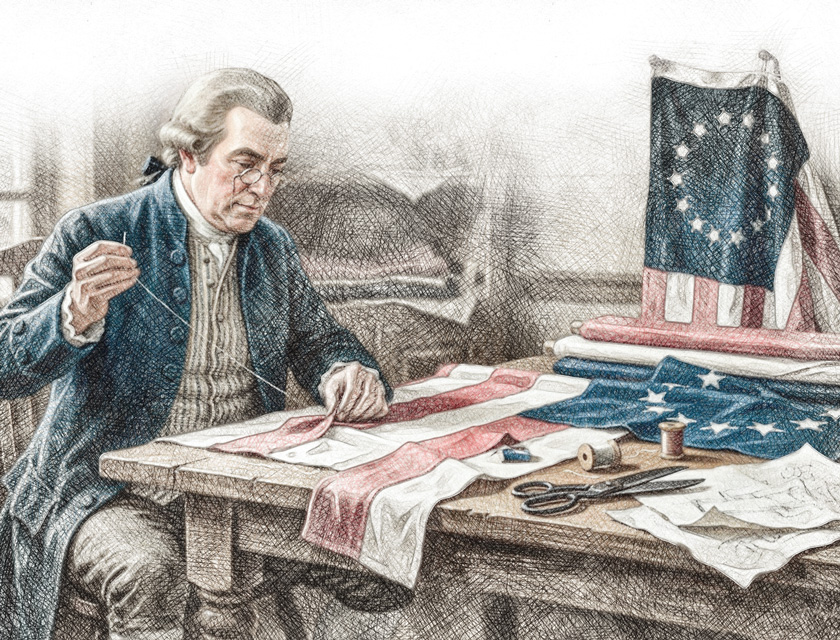
We’re not here to call Mr. Quackenbush a liar or rewrite old textbooks. It can be hard, sometimes impossible, to conclusively prove or disprove events from three centuries ago. Still, the millions who grew up being taught that Betsy Ross designed/invented the American flag known as the Stars and Stripes should leave a lot of room for doubt—and the America250 celebrations are a good time to dive into the subject.
Family fairy tale?
A Biography.com story says there are receipts showing that Ross, who owned an upholstery business in Philadelphia, sewed ships’ flags for the Pennsylvania navy. But it says historian Marc Leepson told the Associated Press in July 2017 “there is no evidence” she sewed the first American flag in front of George Washington in 1776, although she may have sewed some early versions.
Some say the Ross claim is a family fable.
According to Britannica.com, her grandson, William Canby, presented his paper “The History of the Flag of the United States” to the Historical Society of Pennsylvania in 1870. In that account, his grandmother made the first Stars and Stripes flag at Washington’s behest and helped design it. The paper was based on stories from family members and claims from Ross.
But there is no conclusive proof it ever happened. Many historians cite strong indications that the primary designer was U.S. Founding Father Francis Hopkinson.
Evidence favors Hopkinson
One of the signers of the Declaration of Independence in 1776, Hopkinson designed seals for the U.S. Treasury and the state of New Jersey, as well as U.S. currency predating the dollar bill.
Biography.com says that according to the National Postal Museum, Hopkinson wrote a letter to the Board of Admiralty in 1780 requesting compensation for designing “the flag of the United States of America,” the Great Seal of the United States and other items. His bill required payment in the form of a “Quarter Cask of the public wine.”
Journals from the Continental Congress also indicate Hopkinson designed the flag, but his requests for reimbursement were denied because the U.S. Board of Treasury claimed he wasn’t the flag’s sole designer and should have done it simply as a civic contribution.
The first official U.S. flag was adopted by the Second Continental Congress on June 14, 1777, with 13 red and white stripes and 13 white stars on a blue field to represent the original 13 colonies. Several U.S. patents involve the flag, covering both its ornamental design and its use in various products and displays, but the first U.S. patent was not issued until 1790.