
-
Save
She’s all grown up now. As this poised, bright, and inspirational young adult spoke on the panel, advocating to national thought leaders, David Coronado was witnessing a shining symbol of accomplished promise, someone who perfectly embodies the purpose of The Lemelson Foundation’s work on invention education.
Lesly Rojas participated in the InventEd Convening—an early November gathering of national educators, researchers, and practitioners in Portland, Oregon, with the goal of expanding invention education to new classrooms, programs, and communities. Coronado, Director of Invention Education at The Lemelson Foundation and Founder of InventEd, watched with immense pride.
He and Lesly go way back. When they met, she was a middle schooler, a first generation Latina in a low income community seeking direction and purpose, who participated in Oregon MESA’s invention education programming. Coronado himself once served as the organization’s Executive Director.
MESA (Mathematics, Engineering, Science, and Achievement), a collection of nationwide programs designed to support low income students as they pursue careers in STEM fields, leverages invention education to help young people identify real world problems and engineer solutions. Coronado’s position at The Lemelson Foundation expands on that effort by seeking to develop and nurture a national coalition of leaders to ensure that youth, especially those who are underserved, have access to experiences and tools that foster inventive thinking.
“College wasn’t a certainty for Lesly,” Coronado recalled in an Inventors Digest interview after the Convening. “She didn’t yet have a definitive direction, only a strong desire to achieve something significant with her life.
“Her family emphasized that education was important to unlocking her future. Guided by this advice, she joined the MESA program.
“We made sure to present many problem solving opportunities,” Coronado recalled. “Lesly really embraced this across her middle and high school years. Every year, she would select a new challenge, and the educator would guide her and the class through the necessary process to address it.”
Empowering agenda
Contrary to what some may assume, invention education isn’t aimed at creating inventors. It’s about fostering the freedom and rewards of inventive, creative thinking. At its heart, invention education develops a problem focused mindset, the bedrock of invention and innovation.
Coronado affirmed this focus on skill development over content in Lesly’s MESA program. “They weren’t teaching content,” he recalled. “It was about the process of finding problems, unlocking them, and figuring out solutions. We also involved family members,” engaging them and helping them realize the keys to succeeding in college and post secondary education.
Now a junior at Oregon State University as an engineering student, Lesly is the first in her family to attend college.
“She has already played a direct role in her brother’s success, helping him enroll and remain engaged in the MESA program, establishing a connection that has made college a visible and viable pathway for him.”
Coronado reflects on Lesly’s path: “Here is someone who once said, ‘I didn’t really know what I wanted to do or what I could do.’ Yet, through the opportunities presented throughout her education, Lesly unlocked her own powerful and inherent potential. It wasn’t an easy achievement. It took over seven years of dedicated work, continuous support, and her own unwavering tenacity. Today, Lesly is shining bright and lighting the way for others.
In 2024, she testified about the importance of invention education and STEM at the Oregon State Legislature and the U.S. Department of Education.
When discussing why advocating for these programs is so important, Lesly shares: “I walked into that MESA classroom in middle school not knowing what I was getting myself into, and that it would change my life. If invention education can be more available and accessible to more students in the classroom, I believe it would make a big impact in our education system.”
A freedom identity
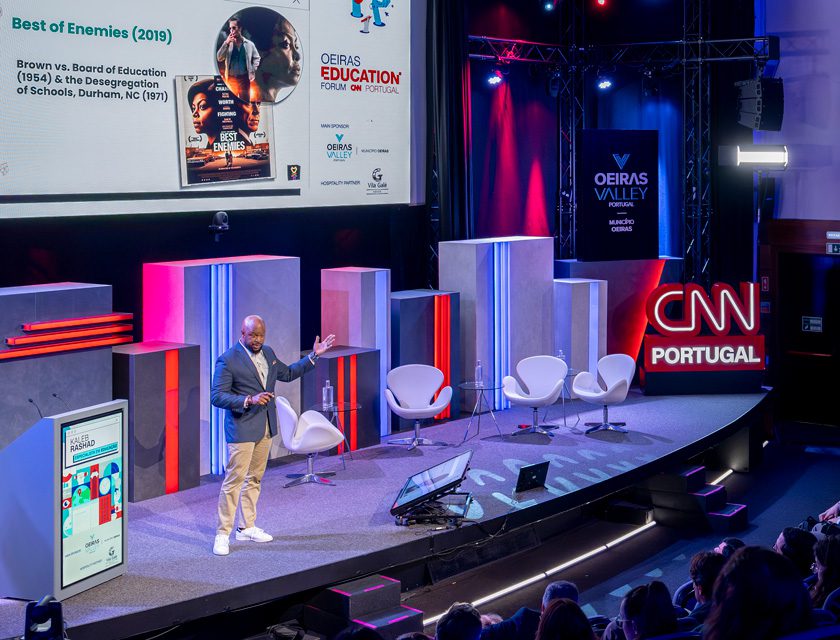
The word “identity” permeates conversations with educators and participants associated with invention education, in the context of young people desperately seeking that precious quality. The process and actualization of a problem solving mindset promotes deeper self understanding, an empowerment and freedom that Kaleb Rashad calls “invention as liberation.”
Rashad can speak personally to this being a worldwide quest. In the past eight years, he has supported the creation of 49 new community based schools in 20 U.S. cities while leading the redesign of existing schools in the United States, Canada, Spain, Hong Kong, and launching a new school in Lisbon, Portugal, from where he recently spoke with Inventors Digest.
He said his partnership with The Lemelson Foundation began “through a shared belief that invention is a powerful lever to democratize agency. Together, we’ve explored how invention education can empower young people to see themselves as problem solvers, creators, and contributors to their communities, to the nation, and to the global community. That alignment has only deepened as my work has continued to center liberation, creativity, and justice as essential components of learning.”
Rashad is CEO and president of Unlocked, Inc., a fitting name, given the word David Coronado used in connection with Lesly Rojas. The nonprofit organization says it advances “liberatory” via partnerships with student groups, educators, family, and community organizers.
He talked about invention being more than a selective skill.
“Invention isn’t merely about engineering or technology. It’s a way of being. It’s curiosity, agency, imagination, and purpose bound together. It’s not a rare ability reserved for a select few; it’s a birthright expression of the creative forces that exist within all of us.
“For me, being born from parents and grandparents who fought against powerful myths, social customs, and ecosystemic injustice, invention is deeply cultural, ancestral… it grows from the creative traditions of the African diaspora (Ma’at), Indigenous wisdom, and the everyday genius of ordinary people who have always shaped the world through necessity, beauty, and joyful resistance.”
The mindset in action
Sometimes, that confluence of attributes is not always realized. Often, it must be unearthed and nurtured.
Coronado observed that in his work, students and teachers often follow a parallel trajectory of self discovery. “Initially, they may doubt their ability to engage in invention education. But with guided support, we focus on helping them recognize that they already possess inventive mindsets. They simply require more opportunities to realize and cultivate that potential. Both students and teachers emerge with a new identity, feeling confident in their ability to invent.”
This journey of transformation is perfectly exemplified by the work of Chelle Myrann. She, two other educators, and five students from the 2010 Cesar Chavez InvenTeam were awarded U.S. Patent No. 8,845,560 on Sep. 30, 2014, for a physical therapy chair.
Myrann has more than 20 years’ experience as a physics, math, and physical science teacher in an inner city farming community in south Phoenix, Arizona, where she coaches a robotics program and developed a four year STEM program at her school. Her connection with The Lemelson Foundation began in 2009, when she applied for and received an 11 team student grant from Lemelson MIT; her 2010 InvenTeam was invited to the first White House Science Fair.
She is visibly thrilled by her mutual connection with students. “The people I get to hang out with, it’s just amazing,” she told Inventors Digest. “But you have to be able to live in that environment and work in it.
Often blessed with altruistic and community oriented students who live economic challenges, Myrann launches the problem centric mindset into action.
“We did a maker’s challenge earlier this year where we competed with a bunch of other schools to create something for low income families with a special needs child. This is a big challenge because they can’t get the specialized equipment as easily as others with more finances.
“The group pulled together. One kid did the electronics, another did the 3D printing, another did all the paperwork and documentation, and they came up with a really good idea and made something that worked. It was amazing.
“In the end, it has to work.”
Multiple inspirational inscriptions from Cesar Chavez are engraved in the walls at the high school named for him. Every year on the first day of school, Myrann endeavors to embed them into mindsets as she shows them to students.
“Two of them are: ‘Surely, the end goal of all education is service to others.’ Another is, ‘It’s not enough for us to advance as individuals and leave many of our friends and neighbors behind.’”
She encourages and furthers a climate of gratitude despite limited resources, well evidenced by her statement that “The Lemelson Foundation and InventEd really affected my whole trajectory as a teacher.”
A student’s vision
Interviewing just one young student who exudes the confidence, energy, and identity of the inventive mindset underscores the excitement and possibilities Myrann lives every day at work.
Jonathan Walker hunched over in the cramped attic space that is his invention lab, a 2025 echo of the traditional garage tinkerer inventor stereotype. At 21, his inventing mindset, appetite, and accomplishments are doubtless far more sophisticated.
His first invention education program experience was five years ago at the Invention Convention at The Henry Ford in Dearborn, Michigan. He won a patent application award for his TactCell Braille Communication System, then won the grand prize for his new pill management system in a contest by Texas Instruments. He also invented an internal combustion engine filter.
Walker, a Robertson Scholar at Duke University and UNC Chapel Hill, served as a correspondent and spoke to an InventEd panel at this year’s Convening about “invention as protest.” He told Inventors Digest his “Spark Talk” thesis was not a complaint, rather an invitation to change existing expectations and processes.
He posited protest as freedom, the word so integral to Kaleb Rashad’s mission for young students: “being able to reject the status quo, and being able to create the world that I want to see, an alternative vision for the world. And that’s not just talking about it. It’s doing it.”
As someone who prides himself on seeing all sides of an issue, Walker can understand how a problem centric focus could be daunting for some young students. “There is a big responsibility in that,” he said. “And that mantle is on your shoulders.”
But he is excited by “the possibility of a world where every kid knows they can see a problem and can invent for it, and that they can create solutions in their own communities, as opposed to people needing to come into their communities and sell solutions.”
He recalled the kind of high school experience he shared with millions of others: “I’m in class, I take notes, I study for a test, and I take the test. Now, it’s much different in that I see a problem, and there’s not an answer already. Rather, I get to think about the problem. I get to think about who it impacts and how it impacts them, and then devise a solution myself, and then build it and test it.”
The inventor mindset he discussed at the InventEd Convening focused on three tenets:
Never be passive, no matter the size of the issue.
Be scrappy with few resources, and treat any problem as an opportunity.
As a young inventor, I don’t have to accept things as they are. I can build the change I want to see in the world.
All inclusive mission
David Coronado’s pride in this next generation of thought leaders and innovators swells when he considers the role of invention education in fostering hope for those who otherwise could never afford to dream. On a broader scale, his advocacy for leaving no mind silenced led to invention education being featured in the federal five year STEM Plan and the United States Patent and Trademark Office’s National Strategy for Inclusive Innovation.
“What’s truly exciting about invention education is its power to ignite empathy, grit, resilience, and potential in young people. We are giving them the critical opportunities and experiences necessary to forge an inventive identity, cultivate the mindsets that will not just take them forward, but that will also empower them to architect the future of their choosing.”
It’s about developing and fostering the light bulb mentality that results in an inventor’s light bulb moment, like the one Lesly Rojas recalled when, during her middle school experience in a program organized by Oregon MESA, she saw the illuminating robotic arm prototype she had created.
“I just remember thinking, ‘Yeah, this is what I’m going to do for the rest of my life,’” she said. “‘I’m an inventor.’”