
-
Save
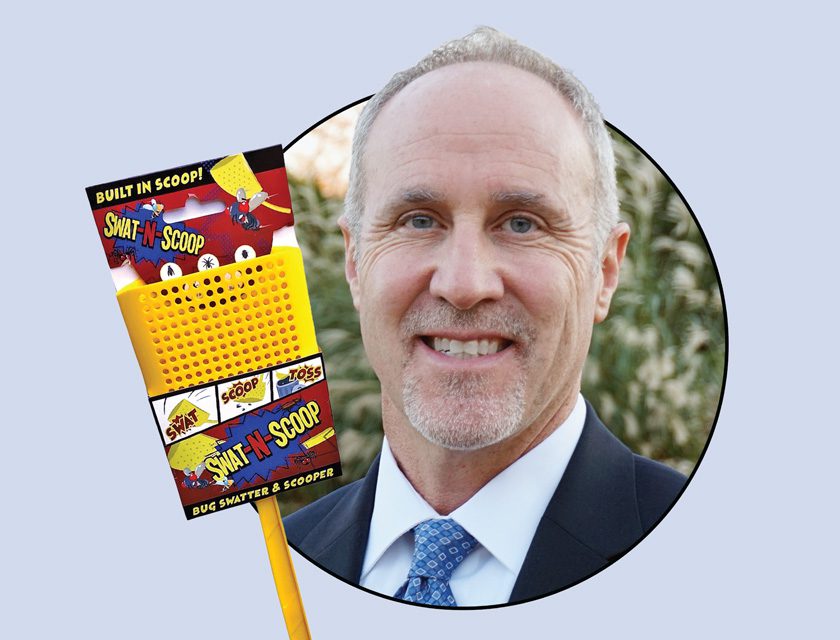
I’ve had the pleasure of knowing toy inventor and Inventor’s Edge founder Scott Putnam for several years and have always been impressed with him, his work, and outlook on life.
Scott has been an inventor and product licensing coach for many years. He’s not only licensed his own products but has brought a product to market and helps other inventors do so as well.
From pitching his product—Swat-N-Scoop, a bug swatter with a built-n scoop—on live TV to authoring a book, Scott shares his insight with us.
When you started out with Swat-N-Scoop, what was your goal?
My original plan was to license it, and I went through all the steps necessary to get it in front of companies the right way.
When did you decide to manufacture it on your own, and why?
As I was pitching the product for licensing the feedback was all very positive, but companies were asking for a real sample they could try out. All I had was my very fragile prototype that was 3D printed. This was about the time I met a fantastic mentor who had been developing products and importing them from China for many years.
My focus had always been on licensing and never seriously considered venturing. He shared his expertise and industry contacts with me while guiding me through the process. He was transitioning toward retirement and was willing to offer me his Rolodex of contacts.
My entire world opened to the possibilities I wasn’t even aware of, since my focus was so intent on the licensing model. Once I realized it was not going to cost nearly as much as I imagined, I decided to go for it.
At this point, I felt confident with the positive feedback received from the industry after pitching for licensing. I was very close to a licensing deal with a large company but ultimately, they wanted me to bring more to the table.
Having a mentor is so important and proved to be exactly what you needed at the time. Talk about the process of manufacturing and selling your own product.
It was a lot more fun than I thought it would be, and much less scary due to having a good guide and mentor. I was lucky that I was handed the keys to the kingdom with taking over his long-established factory contacts.
This made the process so much easier. Because I was venturing the product, I needed to be sure the runway was clear in terms of the patent.
It’s become clear why companies are so concerned with the IP. They don’t want patent infringement lawsuits and I certainly didn’t, either, so I filed a utility patent—which I was granted about three years later.
In the meantime, we moved forward with package design, display pieces, material specs, engineering and figuring out case packs and how the inner cartons would be set up. The factory was fantastic at helping with all of this.
Once the Swat-N-Scoop was manufactured and ready to sell, how did you get it to the retail spaces—and what was your process?
I started with retail stores, then decided to get set up on Amazon. For retail, I started locally with independent Ace Hardware stores and a farm and fleet store, as well as grocery stores.
Once I had distribution in a few stores, it was easier to add more. No one wants to be first to jump in the pool and find out it’s ice cold! To do this, with the help of my seasoned mentor, I created pricing programs for retail, distribution and rep groups, and learned how to work all of the numbers so everybody makes money.
This is where you need to know your numbers as early as possible. Whether you’re licensing or venturing, trust me: The numbers matter.
Companies are going to be assessing the opportunity largely based on margins. It must be a good fit, of course, but the real opportunity for you and the company lies in the numbers.
I pitched to retailers with a one-page sell sheet and video. Then I sent samples and pricing, which felt good to be able to send. For so many years with licensing, I’ve had that request but could not fulfill it.
From there, it was a matter of getting purchase orders and fulfilling them. There’s a lot to learn about becoming a vendor, and it was like learning a new language with some of the vendor forms.
I feel like I gained a master’s degree in business going through this process!
You eventually also got a licensing deal for Swat-N-Scoop while continuing to sell it yourself. How did this happen, and is this something you find typical in the industry?
My first licensing deal with Swat-N-Scoop was ignited at my first trade show, where I met up with Jonah White, the founder of BillyBob Products. I had met him several years earlier as a contestant for his “Gags to Riches” TV show, which is kind of like the redneck version of “Shark Tank.”
We had a nice conversation, and I noticed him intently studying the product. Then he mentioned he was impressed that I had brought a product to market and captured distribution in several stores without attending even one trade show until now.
He asked if I would be open to licensing this to him. He mentioned he would like to change the design and had been looking for new pest control products to expand his growing product line.
I could not think of one reason not to do this, since it would be a non-exclusive and I could keep selling my product as I wanted. I agreed, and we inked a deal over the next few weeks.
Essentially, I just created my first competitor, but I’m making money on every sale they make. It’s been a great experience, and I love being with a growing company so committed to pushing sales forward. Jonah is an amazing guy!
I realized that by venturing my product, it took the vast majority of the risk out of the equation for companies interested in licensing.
I believe for anyone who has been trying to license and not having luck, you can exponentially increase the odds of licensing by moving your product further down the development cycle and ideally selling some units.
This puts you in a much better position because you can now go with the flow of their business model and could potentially create additional opportunities, as it has for me—such as co-branding, white labeling and possibly gaining additional licensing deals or be featured on shows like “Shark Tank.”
More recently, I licensed to a second company that is taking on the brand and expanding distribution into more markets. It’s helped free up my time to focus more on Inventor’s Edge, where I can help people interested in bringing their products to life.
Why did you start this company to assist inventors?
After coaching with InventRight full time for eight years, I decided to start my own company to take my experience working with over 500 people globally to the next level by helping people bring ideas to market in more than one way.
I love coaching and consulting. For me, it’s all about the person, which is why I named the company Inventor’s Edge: It’s about the inventor first, then the product. As a certified life coach, I love working with people to help them go beyond where they thought they could.
What is your basic strategy?
The approach I like best is: Let’s give licensing a shot as Plan A, and see if we can get an easy win. If not, at least you’ll gain some great feedback and industry contacts.
Then if it makes sense, Plan B will be to do something I call “Venturing Light,” where you don’t have to sell everything you own to bring your product to market yourself.
A simple product may not cost as much as you think to manufacture, and you can get it on Amazon and other e-comm platforms fairly easily. From there, it will be easier to get it into retail stores because you’ll have proven sales, reviews, etc.
I can help people through all of this and support inventors with one-on-one coaching, online courses, group coaching or membership, weekly blog, and a podcast called “Inventor’s Edge.” It’s all on our website: inventors-edge.com.
You are also a recently published author. What similarities may there be with inventing or designing a product, and getting that into the world?
In 2013, after a wakeup call from my doctor, I learned about the benefits of plant-based eating and have never looked back.
It feels good to eat in alignment with my value systems. I’ve always loved animals and looked for ways I can contribute to saving the environment. I was a happy carnivore and had no plans to change my eating, but the universe had other plans for me.
I recently published a book titled “Revenge of the Herds: How the Animals We Eat Create Their Unintended Revenge.” This was five years in the making, and there are a lot of similarities to getting a product in the world.
First, you have to have a strong and compelling “why” for doing it in the first place. Resilience and perseverance are required to see it through.
Expect to get knocked down over and over, with an unwavering commitment to getting back up every time.
Without a strong commitment to seeing the process through, it’s just too easy to give up and let it go.
What advice do you have for inventors trying to decide whether to manufacture their own product?
There’s a reason we have creative ideas, and they always seem to tap us on the shoulder. It’s too easy to ignore this and stay in our comfort zone, binge watching on Netflix.
The real question is, when are we going to do the things that scare us? In my opinion, this is where life really begins … just outside the comfort zone.
Making the decision to take the plunge to venture the product yourself depends on a lot of things.
First, be sure to have a good understanding of what’s involved so you know what you’re getting yourself into.
We’ve all heard the nightmares of having a garage full of product they can’t sell. Having it made is not the hard part, and a garage full of product is OK as long as it moves out of your garage.
Look at the numbers and make sure you have good margins. Know your category well, and be sure your IP is locked up, or will likely be soon.
Working with good people can help you navigate this process.
Best advice? Get help from those who have been there. Be careful with any companies that promise you the moon. Research any company you’re thinking about investing in.
There are no guarantees, even after you get product into stores. Your product has to sell.
Do your homework and when you feel this is the best opportunity for you over any others, then it makes sense to go for it.
Anything else that wasn’t covered today?
Venturing can lead to things you can’t imagine. For example, my daughter and I were featured on Amazon Prime Video’s show, “Buy It Now” (Episode No. 2).
We had 90 seconds to pitch Swat-N-Scoop to a live studio audience as part of a contest.
You want to talk about stretching your comfort zone!
It was an amazing experience for both of us and incredibly fun to tell the story of the product and our journey.
It’s all part of the adventure of life, and it’s usually the stuff that scares us the most that hides our biggest opportunities.
Don’t wait for “someday” to give the world your gifts. There’s no time like the present.
You got this, and you deserve it!