
-
Save
After decades as a wireless pioneer—one of the architects behind 4G and 5G wireless infrastructure and a prolific patent holder in radio frequency (RF) engineering—Shih Mo assumed retirement in 2016 would be restful. He had helped shape how the world connects. He had built companies. He had earned the fairway.
But golf grew repetitive. Standing still felt unnatural. His mind didn’t slow down just because his calendar did.
And somewhere between tee shots, he began thinking about signal speed—not for smartphones, but for survival.
“I spent my career in wireless communications and RF (radio-frequency) engineering, but I’d never worked in medical devices,” he said. “Around the same time, both of my parents died from strokes.”
That got him thinking.
“We’re in the 21st century, and stroke is still one of the leading causes of death and disability worldwide. With all the technology we have, why are we still losing so many people to something that’s often treatable if caught early enough?”
Though immersed in the personal loss, his curiosity accelerated when a colleague mentioned that medical device companies had been using wireless chips from his former company for years.
The convergence was quiet but persistent: What if wireless technology could be used not just to move data but also detect catastrophe inside the human brain?
That question eventually became Tiposi.
The microwaves factor
Shih’s expertise is in RF engineering, the invisible architecture behind modern connectivity. Having built the backbone of 4G and 5G, he understands signal penetration, interference, propagation, latency. He understands how microwaves behave in complex environments.
Microwave sensing is not new. It has long been used in military ground-penetrating radar systems to detect buried landmines. But he saw something different: What if those same principles could detect hemorrhage or ischemic changes in brain tissue?
The leap between a technology that can be used for mobile phones to the battlefield is where this inventor’s true colors unfurled—a classic cross-domain thought. Shih jumped in.
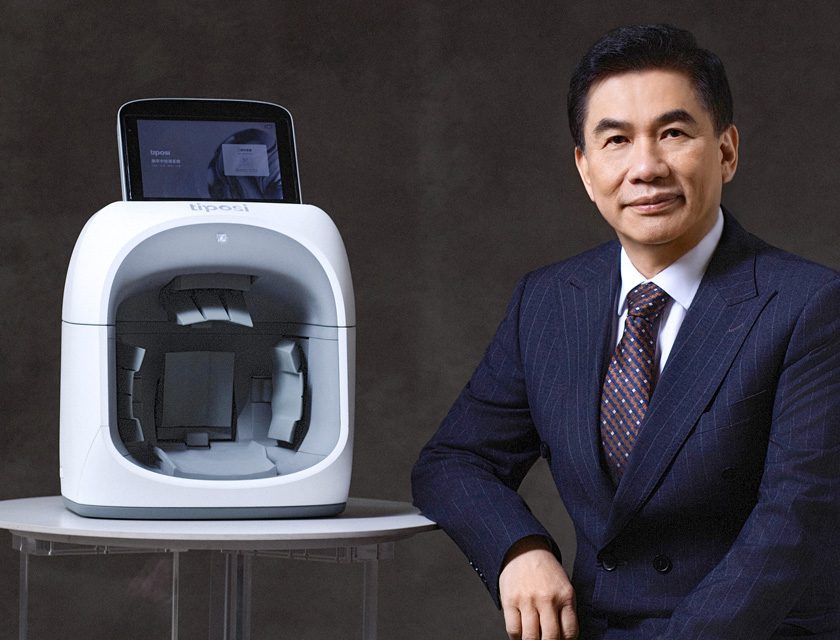
Tiposi uses microwave wireless imaging to detect stroke in seconds, and not in an MRI suite that takes hours to reach. This can detect life-threatening situations during a hospital transfer, in an ambulance, at a bedside—and in clinics without advanced imaging infrastructure.
Already used in hospitals in China, the device—a 2026 Consumer Electronics Show Innovation Awards Honoree® in the AI category—is designed to address one brutal truth of emergency medicine: When “time is brain,” the ride to the MRI is often too long.
His own gold standard
Shih admitted that early on, he thought about competing with MRI. If microwave imaging can create images, why not replace the gold standard?
Because the gold standard is entrenched. Instead, he reframed the opportunity.
The real problem wasn’t image quality. It was the delay. His opportunity lay in the gap between symptom onset and definitive imaging that happens every day, everywhere in the world: the time it takes for emergency transport, being far away in a rural clinic or a traffic jam that steals neurons by the minute.
He found the unserved interval.
That’s strategic maturity. And it’s a lesson for every entrepreneur tempted to attack giants head-on: Don’t fight the incumbent on its strength. Find the suffering it doesn’t solve.
Time, money recalibrated
Development began in 2017. Shih thought it would take four years. It has taken nine—because deep innovation in regulated industries resists optimism.
He came from telecom, not medical devices. Early assumptions about sensor placement were wrong.
RF interacts with biological tissue differently than with antennas and base stations. Designs were scrapped, form factors reimagined. Months evaporated.
Then, COVID hit.
Hospitals closed to external testing. Labs went dark. Hardware could not be prototyped over Zoom. Funding tightened in 2022.
Experimental results didn’t align cleanly with theory. Timelines slipped. Investors became restless.
He describes those times as the worst period—not because the science failed, but because his financial runway shrank while proof remained incomplete. His biggest fear wasn’t technological collapse; it was running out of time before validation.
For inventors reading this, this founder says: “Budget three times what you think—in time and money.”
The moment of validation
One moment recalibrated everything.
During early hospital testing, Tiposi detected a stroke that CT and MRI had missed. Experienced neurologists, accustomed to traditional imaging, stared at the results in awe.
“My most joyful movement was watching the doctors’ faces when we showed them the results,” Shih said. “These are experienced neurologists who’ve seen thousands of scans, and they were looking at our technology like it had just done something they didn’t think was possible.”
In product development, there’s a massive difference between incremental improvement and category disruption. That moment signaled the latter.
For Shih, it wasn’t about outshining MRI. It was about proving that portable, RF-based brain monitoring could catch what standard pathways sometimes overlook—and do it quickly—that critical time gap when people were dying.
That’s when he knew his second professional act might matter more than the first.
Escaping a startup trap
But soon after loomed a Catch-22 that revealed his operational maturity.
As with most startups, the Milpitas, California-based company initially planned to outsource manufacturing and keep R&D internal. Let an original design manufacturer scale production.
Then, reality intervened. No serious manufacturer would take low-volume work unless it would be paid premium prices—“sometimes millions for small batches,” Shih recalled. But you can’t promise volume until the product is proven, a classic startup trap.
So he built internal manufacturing capability. He calls it his company’s “manufacturing academy.”
The company could not afford to make the tiniest of mistakes. “One defect could mean a missed stroke. You have to be self-responsible for how your product is made.”
As someone who has shepherded countless launches, Shih knows that founders must not treat manufacturing as an afterthought. He understood that from the start—or at least, early enough to correct course.
The senior CEO advantage
As someone with a history of building and scaling companies, he refers to himself as a “senior CEO.”
He has negotiated international manufacturing contracts. He has managed cross-border engineering teams. He knows when to raise capital and when to wait. He reads financials with fluency. He knows how quickly hardware timelines expand.
The company began in 2017 with a neurologist and a handful of R&D engineers. Everyone did everything.
As prototypes matured, manufacturing expertise became essential. As clinical validation approached, regulatory and hospital collaboration teams expanded. In 2024, internal manufacturing scaled, pushing headcount significantly higher.
Today, roughly 60 percent of the team is engineering and R&D, 20 percent clinical, 20 percent management and operations.
That ratio wasn’t pre-planned. It evolved in response to recurring bottlenecks.
The company holds multiple patents around its core dual-comb spectroscopy and RF-based detection technology, along with a trademark for the Tiposi brand.
The IP strategy is pragmatic: Patent what can be reverse engineered. Keep proprietary manufacturing processes and calibration algorithms as trade secrets.
Invention isn’t just about discovery. It’s about protection architecture.
Loving the problem
Asked about how he manages stress, Shih didn’t talk about work-life balance. He talked about belief.
For inventors, the hardest discipline isn’t technical; it’s psychological.
“You must love the problem itself, not just the idea of success,” he said.
His advice is direct.
Don’t attack established systems head-on. Instead, “Find the gap the established players aren’t filling. For us, it was the time gap before patients reach an MRI.”
Bring in domain experts immediately if you’re crossing industries.
Perhaps most important: “Hire those who believe in your mission. They will stay when things get rough. My biggest fear through this process was not being able to deliver, and part [of that] might have been having to lay off valuable team members.
“My team was committed to finishing what they started, and we made it through. Together.”
Chasing faster minutes
The next focus for Tiposi is on regulatory pathways and broader deployment. Long term, Shih sees a broader platform for portable brain monitoring—traumatic brain injury, seizures, cognitive decline—and eventually, perhaps, new forms of brain-computer interfaces built on RF rather than traditional EEG.
But he is not chasing futurism. He is chasing minutes.
When he left the golf course, it wasn’t to build another telecom empire. It was because just playing golf felt wrong while other kinds of more important strokes remained undetected.
In an industry obsessed with first-time founders and overnight disruption, there is something particularly special about a man who retired, grew bored and decided the next signal he cared about wouldn’t be data. It would be life.
And after a first career that connected billions of devices, this one may connect something far more fragile: the moments that make a life salvageable.
Details: tiposi.com
-
Save