
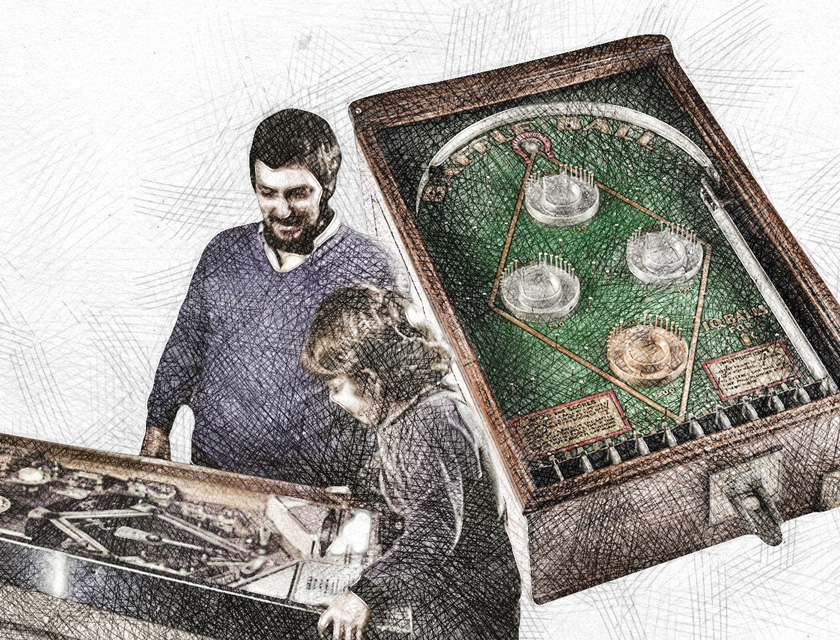
Identifying the inventor of the pinball machine is somewhat like playing the game: The answer pings and caroms all over the board, depending on which version in the game’s long evolution is discussed.
One certain aspect of the game’s history is its less than wholesome background.
Pinball has its origins with the French game Bagatelle, which was played on a tabletop with marbles. It’s widely believed to have been introduced in America by French soldiers fighting in the War of Independence.
Wizards of pinball innovation included Cincinnati inventor Montague Redgrove, who in 1871 was awarded U.S. Patent No. 115,357: a model of a Bagatelle game that features a spring-based ball shooter, which remains integral to today’s pinball machines. The first coin-operated machine came 18 years later.
Gottlieb’s Baffle Ball and Bally’s Ballyhoo became popular in the 1930s, a decade in which the electric pinball machine and automatic scoring machines were introduced. Harry Williams’ introduction of the tilt mechanism in 1935—a simple mechanical sensor later refined as an electrical pendulum tilt—became standard in all machines.
Gottlieb’s invention of the flipper in 1947 changed the game forever, adding an element of quick reaction and timing for players. It also gave the game a long-needed boost of legitimacy.
‘Slimy crews of tinhorns’
The curiously named whatitmeanstobean-american.org provides some background:
“With Prohibition winding down [in the early 1930s], organized crime was eager to take on pinball as a more acceptable alternative to the highly illegal slot machines of the day. It was a cash business, and it was a good one. For almost 30 straight years, pinball made more money than the entire motion picture industry.”
The games involved shots that may or may not land on random targets for prizes. By the middle of the 20th century, the vast majority of machines were manufactured in Chicago—known as an organized crime mecca under crime boss Al Capone.
Though the machines were legal, many viewed them as gambling devices. New York Mayor Fiorello La Guardia described manufacturers as “slimy crews of tinhorns, well dressed and living in luxury on penny thievery.” Police routinely raided pinball halls, seized machines and destroyed them.
But the introduction of flippers, combined with the earlier tilt mechanism, helped pinball become more a game of skill than chance. Bans in U.S. cities eventually softened, although pinball was not legalized in New York, Chicago and Los Angeles until the 1970s. Oakland, California, still had a ban on pinball machines as recently as 2014.
Revival? How strong?
Many Americans Of A Certain Age recall spending a lot of time in pinball halls at college pubs in the 1970s, when a new blitz of sophisticated machines was launched with various pop culture themes. But the craze wound down in the 1980s with the introduction of video games and has not seen a major revival.
The game’s last pop culture 20th-century hurrahs—reminiscent in The Who’s 1969 hit “Pinball Wizard” and Paul Newman’s boozed-out lawyer character playing the game in “The Verdict” in 1982—may be its last. Or not.
Despite the significant decline of pinball arcades through the past several decades, Medium wrote three years ago: “The pinball market is surprisingly fresh and loaded with products that people want to play, both licensed and otherwise.”
And Business Insider reported last October: “Now, in the era of arcade bars and basements, the classic game has earned an extra life. New technology, digital integration, and motivated collectors are fueling a pinball renaissance.”
No irrefutable statistical data were provided in either case, suggesting the game’s staying power may rest in the hands of a loyal faction of diehards hoping not to tilt.