Conveyor belts have made many improvements since their introduction in the 1700s
“Oh, this is easy!” Lucille Ball says to “I Love Lucy” co-star Vivian Vance as they begin wrapping chocolates approaching them on a conveyor belt.
During the past 74 years, millions of people around the world have seen what happens next in the iconic physical comedy performance that first aired on September 15, 1952. The conveyor belt speeds up; the two newbie workers frantically stuff chocolates in their mouths and elsewhere to try not to fall behind.
Real-life conveyor belts are usually more reliable, with proven successes in various stages dating to the concept first known in the 1700s. The process has evolved with no true inventor, though Thomas Robins of New York City is generally acknowledged to have received the first patent for the modern, heavy-duty conveyor belt, in 1911.
Wood-and-leather start
Robins created more efficient conveyor systems for the Edison Ore-Milling Co. His invention (U.S. Patent No. 981,312, more than four years after the application) was designed to carry coal and other materials over short distances, using steel rollers and rubber belts to carry heavy materials without breaking down.
The design, which won the grand prize at the Paris Exposition, was the basis for the steel conveyor belts that became popular in the food industry.
But as with much innovation, Robins’ system improved on a concept long in existence.
According to industrial supplier SEMCOR, American inventor and industrial automation pioneer Oliver Evans included a wooden conveyor belt system in his patented design in 1790. His invention, which included bucket elevators and modified Archimedean screw conveyors, resulted in a flour mill capable of continuous manufacturing with no human labor.
The late-1700s conveyor belts, used at ports moving goods on and off ships, were made mostly of wood and leather and operated by pulleys and hand cranks.
Steam-powered belts began in the first decade of the 1800s, with its first recorded iteration used in the British navy for food production. But these belts were still fragile and susceptible to too much heat or cold. The introduction of a vulcanized rubber belt system in 1844 made conveyor belts more attractive in a wider number of industries—including mining with its heavier materials.
Further belt-tightening and advancement came with Swedish engineering company Sandvik producing steel conveyors for the transportation of mined aggregate and coal in 1902; mining engineer and inventor Richard Sutcliffe introducing the first underground conveyor belt in 1905, made of cotton and rubber; and Hymle Goddard patenting the first roller conveyor in 1908.
Ford’s ‘better idea’
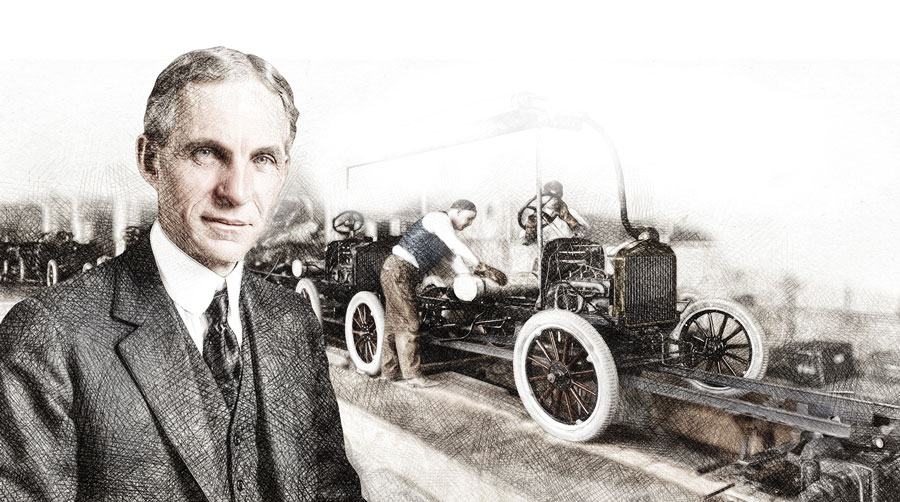
Shortly after Robins’ patent, Henry Ford took the conveyor belt concept and streamlined it to the point that many falsely believe he invented it.
First employed on December 1, 1913, Ford’s system revolutionized manufacturing.
His standardization of parts allowed for interchangeable components, reducing the need for custom-fitting and enabling faster assembly. Each worker specialized in a specific task, increasing efficiency and reducing training time. The moving belt’s continuous flow of materials and components minimized downtime and maximized the use of labor and resources. The process also allowed engineers to conduct extensive time and motion studies to identify and eliminate production inefficiencies.
But many workers hated it.
“The line was seen as an insult to skilled craftsmen and another example of the overwhelming patriarchal control a company could have over its workers in the age of mass production,” according to Smithsonian magazine.
“The horror that was felt about assembly-line style mass production is seen in films like Charlie Chaplin’s ‘Modern Times’ and Fritz Lang’s 1927 film ‘Metropolis.’”
Was the chocolate conveyor belt mayhem in “I Love Lucy” borrowed from earlier works?
Latter-day improvements
Synthetic belts came to the fore in the 1960s. Their 1940s origins can be traced to World War II, when materials to create conveyor belts were harder to get and necessitated the use of new materials.
Synthetic belts provided unprecedented resiliency and flexibility.
Plastic modular belts developed in the 1970s continued the flexibility trend, featuring interlocking blocks that can carry heavy items and are easy to replace—along with the rust-free properties that make the belt an ideal carrier for food.
Today’s conveyor belts move everything from luggage to people on moving walkways. Smart technology allows the belt conveyor to communicate with other machines and analyze power usage to reduce consumption when full power isn’t needed, or shut themselves down when not in use. The belts can also detect safety hazards.
Before filming their famous scene, Lucille Ball and Vivian Vance visited See’s Candies factory in Los Angeles. They dipped chocolate and met employee Amanda Milligan, who appeared in the episode.
Founded in 1921, the company still exists with 250 worldwide locations—evidence of America’s love of candy and the proven benefits of literally keeping things moving.