Sharing first-time lessons and successes working with a product development company and artist
As I finalize and review my first self-published game after having about a dozen or so available for retail from licensing, I reflect on my journey and look ahead. I hope what I share helps you in whatever path you choose for your product in progress.
Often, we think we want control and the final say about our product—until we are actually presented with it and everything falls on our shoulders as inventor and entrepreneur. We may think after licensing a product “I would have done this or that, or I could have done better,” but the reality is that every decision, every small detail becomes a huge factor when you are getting a product ready for the market.
For my upcoming card game Guacnado (releasing in the fourth quarter of 2026) that I am self-publishing, I had to consider the following: material, artwork, box size, value and perceived value of a product, how to sell it, where to sell it, marketing, and do I sell it under my current business name or start another business solely for publishing games?
Then I had to learn about all the testing information for different countries and the information that needed to go on the back of the box, including barcodes and QR codes as well. I am learning a lot, to say the least, which is a big reason I decided to self-publish.
One of my biggest lessons was the importance of getting several price quotes for my product. I contacted a few factories for this.
I also learned that factories will give you and quote you exactly what you ask. The problem with this is that you may not know exactly what you need or want, or the options available, the first time you are manufacturing. In doing this, I received several quotes and even had one factory make a sample of what I wanted. I thought it turned out pretty well.
Crucial value insight
Excited about the outcome, I then spoke with GW Development. This is not a factory but a product development company—helping inventors/companies take their ideas from prototype to production, optimizing the product and packaging for cost and retail value, and connecting them with the best manufacturing partner.
When I met with the company to discuss my product and pricing, I got many different options and viewpoints with where I was headed with my product. I showed the sample from another factory without sharing who made it.
GW Development talked with me about value and perceived value of a product, and that given how I had my game at that time, I would not be able to sell it for how much I wanted—that customers would not see the value, simply because of the current box size and the games that currently sell and compete for the shelving space at that price. We discussed box size options and how to create a little something “extra” in my card game.
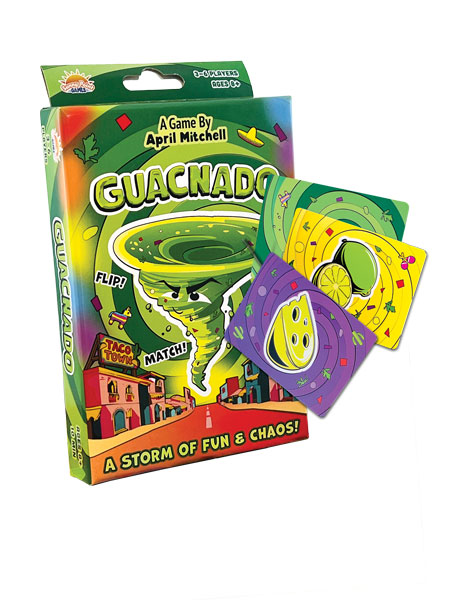
This is when the Taco card in my game became a Taco made of punchboard. It was larger than the card, which helped raise the value and added to the table presence of the game.
After our discussion, this company sent me a few different box size options for me to go through and evaluate. Then we met to discuss them and their benefits. Before this, I had no idea there were so many options of how boxes opened and where they opened, the differences in size, etc.
Choosing a better-quality box and a simple change to my game components raised the value of the game and the price people would be willing to pay for it.
Designer’s touch essential
I had the pleasure of working with a fantastic art designer, Michelle Spivak, for my game. I was very excited with how everything turned out, but with the change of box size and the Taco some edits were now needed.
GW Development also gave feedback on how to make the artwork pop a bit more on the cover of the box. It made a list of suggested changes to the box design; Michelle made the suggested changes, as well as updating the design based on the new box size and changes to the Taco.
These changes helped will allow the game to “jump” out a bit more on the store shelves (see photo of both game boxes). When choosing an artist, be sure to choose someone who is willing to work with you on things and make the changes needed if they may come up.
When taking a project all the way from conception to selling to consumers, we become the project manager and art director. For me, it was nice to have someone else share thoughts and feedback on various items such as box size and style, game components and art setup. Not only did these little changes make a big difference, but having a larger box helped not have things feel crowded.
Saving time and money
The next time I take another product to the market, I will start with working with a product development team.
This will save me time and money in the long run by not having to redo things on the project as often. It will allow me to present my product and get feedback and direction for possible ways to go at the start.
From there, I’d hire the artist (most likely would have one in mind already) to work on things after receiving the correct size files needed and will be guided from there, yet still make all final decisions.
This time, I will know and understand all possibilities for the product from the beginning—including box size components and pricing. This works well because the development team works with several factories and can find the best options, materials and pricing instead of being pigeon-holed into what one factory has to offer.
I didn’t know what I didn’t know when I started my self-publishing journey. Could I have sold my first smaller box of Guacnado? Sure, but the new box and changes take things up a notch, and I feel like it’s in a whole new value category than before.
The finished product is now polished and market ready. I truly have enjoyed this journey and opportunity, and am grateful for all I’ve learned along the way.
I also had a lot of support and help from game publisher friends. These people are experienced with so many things, and kindly shared their knowledge and expertise.
Working straight with a factory can be a great fit for some people, especially if they have someone working as a project manager giving options and feedback. For me, I found working with a product development team helped me turn a good product into a great product.
A big shout-out to GW Development for all its help bringing Guacnado to life! I will sell the game on Amazon and will also be trying to get it into stores.
If you would like to follow my journey, please follow me on Instagram (@aprilmitchell_meant2invent) so you can see more behind the scenes of the game—including how I learned to take photos of the game, see the first prototype and more—as well as learn when it is available for purchase.
For more information about the game:
4ascreations.com