When marketing your product or invention, word of mouth shouts louder than anything else. Every time.
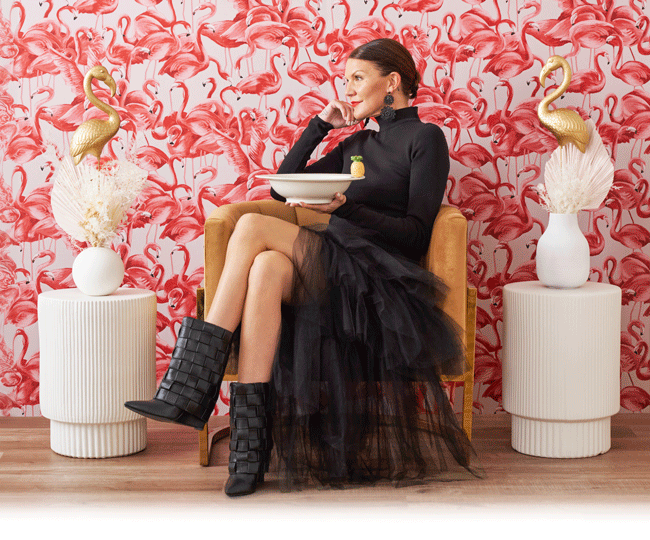
On the occasions when that word of mouth morphs into a like-minded, impassioned throng who collect your product, the result is fandom—something very rare. And Nora Napientek is a very rare inventor/entrepreneur.
For more than 20 years, the beautiful and energetically delicious Chicago native has built an extraordinarily devoted following around a very simple invention: interchangeable, hand-painted ceramic “minis” that fit into serving pieces.
A customer can use the same platter, each with a small hole in the edge into which one can press in an adorable painted porcelain Christmas tree, pumpkin, Star of David, Easter bunny, basket of flowers, or a porch goose with a ribbon bow around its neck.
Nora’s concept saves a lot of pantry space from multiple sets of dishes for each holiday. But that’s not the reason she’s so successful.
People collect her minis, trade them and scour eBay for retired pieces. They belong to Facebook groups devoted to them. Hundreds line up at Nora’s personal appearances, sometimes traveling hundreds of miles. Gen Z has discovered the brand on TikTok, bringing an entirely new generation into the fold.
These are not your granny’s Hummels in her window-paned china cabinet. This is Hello Kitty or Labubu-mania on steroids—and it’s not like the Pet Rock that came and went within the same year.
nora fleming isn’t a story about dishware with interchangeable ceramic minis. It is a case study in how a product trips a human emotional trigger and, in the process, turns customers into fans.
Watching customers pays off
Before there was nora fleming, Napientek was a young mother of two who owned a paint-your-own pottery studio. It was a great business to have while raising small children and gave her a front-row seat watching how women were using tabletop products.
She noticed customers painting separate platters for different occasions: a turkey platter for Thanksgiving, a pumpkin and fall leaves one for Halloween.
She remembers thinking: This is crazy. Why did someone need to store a different serving piece for every holiday?
So, she began sculpting small three-dimensional figures that could be changed on a single platter. She sold them at craft fairs and church bazaars. To her fascination, people started asking where they could get them and wanted more.
“It was a very slow, natural beginning, without a big launch strategy behind it,” she said. But her younger brother, Jon Neidlinger, saw “something magical here. We need to turn this into a business.”
Through a friend who had experience making porcelain bedpost finials, Jon traveled to China to see whether the pieces could be manufactured. That presented the next very familiar entrepreneurial problem: money.
Five banks refused them for the $30,000 startup capital needed. Nora went to her grandmother, who cashed in a CD and loaned them the money. Her name, Fleming, got second billing in return for the favor.
Their first shipment, 12 different designs with a minimum order of 144 of each, landed in Nora’s garage. From there, they went to their first wholesale gift show and began taking orders.
There’s a lesson here that inventors sometimes overlook. Nora didn’t invent something because she was determined to become an entrepreneur. She noticed something consumers were doing that didn’t make sense and found a better way for them to do it.
The customer as the artist
What Nora understood later, however, may be even more important than what she understood at the start.
“Few products allow the end consumer to become the artist,” she said.
That sentence gets to the heart of why the product has had such longevity. A nora fleming platter isn’t really finished when the customer buys it.
The customer finishes it.
“The customer chooses the mini that goes into it that day. She decides whether a pumpkin means Halloween, Thanksgiving or simply fall. One family might choose a horseshoe because they love horses; another because it represents luck. Someone else chooses a heart because of a person or memory attached to it.
“It gives control to the owner to create their own piece of art.”
What may sound like a small distinction is enormous from a marketing perspective.
Personalization gives the consumer some ownership of the product, and ownership creates attachment. Once that happens, you aren’t simply asking someone to come back and buy another piece of merchandise. You’re giving her another way to express herself.
It also turns what might have been a one-time purchase into a product with almost unlimited reasons to return. Now, that’s a customer.
Know your business
Nora has turned down many opportunities.
She has watched plenty of brands grow by trying to be everything to everyone. Her philosophy: “You have to pick your lane.”
That conviction was tested when nora fleming was still relatively small and received a large purchase order from Bed Bath & Beyond. At a point when the company could have used the money, she said no.
Independent boutiques had helped build the brand, and many of those small retailers depended on it. She believed that putting the line everywhere could damage both those relationships and something else that turned out to be critically important: the way customers discover the product.
nora fleming needs a little explaining the first time you see it. Nora found that placing the product at the point of purchase was brilliant because a store employee can pick up a platter, remove the mini and show a customer how it works. She compares it to cosmetics in a department store, where someone behind the counter brings the product to life.
The company puts significant effort into educating its retailers, even creating the soon-to-launch nora fleming University to teach stores how to merchandise and sell the line.
Could the product be sold in a Target or Walmart?
Nora questions whether it would work the same way, sitting anonymously on a shelf. “We have experimented repeatedly with packaging groups of minis together, such as Q4 holidays or romance or football team collections, but they want to pick them themselves,” she said.
For inventors, the bigger point is that distribution isn’t simply about getting into as many doors as possible. Where and how a product is sold can become part of the product itself.
nora fleming’s independent retailers aren’t merely stores. They are the local evangelists who teach customers how to enter the world of the brand.
The next level: Collecting
Collectability takes fandom to a different level.
nora fleming maintains a relatively small core collection, while other minis rotate in and out. New pieces arrive several times a year; older ones are retired. That creates anticipation and urgency.
The company says it isn’t intentionally trying to create a speculative market or convince customers they need every single mini. Nora describes the sweet spot as the person who buys the pieces that speak to her personally.
Fans took it further on their own.
In numerous independent Facebook communities, collectors show their displays, trade pieces, hunt for retired designs, speculate about what might be coming next and help one another locate hard-to-find minis. Some of the largest groups collectively represent tens of thousands of memberships. They were largely created by customers, not the company.
This created a secondary market.
A purple-and-gold party hat mini has sold for more than $2,000. An original pair of Victorian shoes sold for $1,604, a spooky spider for $1,525. A private collection of more than 375 minis was once listed for $40,000. Normally, minis sell for $18 each.
Scarcity contributes to those prices, but scarcity by itself doesn’t create fandom. If you discontinue a product nobody cares about, all you have is obsolete inventory.
Scarcity becomes powerful when people are already emotionally invested.
From grandmothers to Gen Z
After 22 years, another remarkable thing is happening to nora fleming: The collecting habit is becoming generational.
Nora now meets grandmothers, mothers and daughters who all collect. She hears people say, “My grandmother got me started.” Families come to signings together and give minis to one another as gifts.
At the same time, Gen Z has begun discovering the brand through TikTok.
@WabbyRose discovered nora fleming independently and began sharing her collection. Her content helped the company’s paper towel holder go viral, and younger influencers have since begun documenting their own collections.
Then came the “porch pal,” a tiny version of those wonderfully kitschy decorative porch geese that many people remember from their mothers’ or grandmothers’ houses.
The company noticed porch geese coming back into fashion and created the mini almost on a whim. It placed a relatively small initial order. It sold out in days. A reorder sold out as well. At the time of this interview, the company was on its third order.
What’s happening there is more interesting than the TikTok trend. Gen Z is rediscovering objects they remember from childhood and reinterpreting them as their own.
The company didn’t abandon its identity to attract a younger consumer; the younger consumer found something meaningful in the identity the company already had.
That is a much harder feat, and a much more sustainable one.
Understanding Nora
You cannot fully understand the nora fleming fan base without understanding Nora herself.
Several times each spring and fall, she visits select independent retailers around the country for signing appearances. Hundreds of people can show up, with attendance sometimes reaching 600. Mothers and daughters, sisters and groups of friends make a weekend of it.
For the retailers chosen to host these events, the impact can be enormous. The company says a store can sometimes generate more sales during a single signing than it would during an entire holiday season.
But conversations with Nora and her marketing director, Danielle Elderkin, revealed that people aren’t waiting all those hours simply because they want an autograph.
They want Nora.
Elderkin remembers noticing Nora at an event before she joined the company. She wondered, “Who is that?” Her energy attracted people.
“Nora has this magic,” she said. Even with hundreds of people waiting to meet her, “she makes that person feel like no one else is there.”
The fans come with stories, and Nora listens to them. That relationship is strengthened by the fact that doesn’t present a highly polished, protected version of herself to her customers. She talks about her family and has been open about painful parts of her life—including the unexpected death of her brother, her daughter with medical complexities and the loss of a partner to suicide.
“I wear my heart on my sleeve,” she said.
That vulnerability matters because the brand is built around life moments, and life moments aren’t all happy.
She remembers hearing about a woman experiencing domestic violence whose husband had shattered her beloved nora fleming collection. Other collectors began sending replacements to her.
Nora is also a philanthropist. Shortly before Jon died, the siblings selected St. Jude Children’s Research Hospital and began creating dedicated minis whose proceeds benefited kids with cancer.
They raised $1.2 million—an extraordinary amount for a company that had only 15 employees. Some of those pieces sold out within hours.
“People want to be part of something bigger than themselves,” she said.
This April, a one-of-a-kind Creative Quill mini hand-painted by Nora sold at auction for $3,200 to benefit The Chicago Academy for the Arts. Once again, the object was simply the vehicle. People were buying the participation.
A consistent culture
Talking with Nora revealed that the external fan culture doesn’t seem much different from the internal company culture.
nora fleming is still a surprisingly small operation, with 27 employees and a larger network of outside sales representatives. Family members work there. Friends work there. During the fourth-quarter rush, everybody packs boxes.
She is particular about saying that people work with her, not for her. Employees describe an environment where everyone takes ownership, and where job descriptions become fairly irrelevant when something needs to get done.
She also learned early that a founder should surround herself with people whose abilities are different—and better—than her own.
“I surround myself with others who are smarter and better than I am,” she said. “It’s uncomfortable. You have to give up control, then trust them to do their jobs.”
That sounds obvious until you spend time with entrepreneurs. Inventors in particular can become so understandably protective of what they created that they accidentally make themselves the bottleneck to its growth.
Nora’s approach is the opposite. Protect the idea, certainly. Protect the values even more. But let other talented people make the company better.
Amazing ‘grace’
Nora often uses the word “grace.”
She calls her success “growing with grace.” She doesn’t want every decision reduced to the bottom line.
Company meetings are more about the well-being of employees and their families, if retailers are succeeding, and whether the company is still having a positive impact on the people around it. Employees don’t pore over spreadsheets; everyone is asked for a simple thumbs up or thumbs down.
“What is my greater purpose?” she says she asks herself when making decisions. “Nine out of 10 times, it’s not the bottom line.”
Fandom is one of the few things in marketing you cannot manufacture simply by spending more money. You can buy awareness. You can buy reach. You can buy trial. You can even buy a certain amount of repeat purchases.
You cannot buy someone caring. That has to come from somewhere else.
In nora fleming’s case, it comes from allowing customers to inject themselves into the product; giving them something new to anticipate without abandoning what they already love; protecting the retailers who helped create the brand; listening to collectors; showing up in person, and creating a company that seems to care as much about belonging as it does about selling.
Perhaps that explains why something as small as a ceramic pumpkin or bluebird can become so emotionally charged.
A pumpkin isn’t just a pumpkin if your mother put it on the Thanksgiving platter every year. A horseshoe isn’t just a horseshoe if someone searched everywhere to find it because it reminded her of you. A retired mini isn’t simply discontinued inventory when three generations of women in one family have memories attached to collecting them.
And a serving platter is no longer just dinnerware when 600 people are waiting in line because they want to tell the woman who invented it what her product has meant in their lives.
Every inventor dreams of creating a product people love. nora fleming offers a slightly different lesson.
Maybe the real opportunity is to create a product that gives people somewhere to put that love.
That is when customers become fans. That is rare.
Details: Norafleming.com