NASA at the Great American State Fair.
The words go together like the stars and stripes. The June 25-July 10 appearance by the National Aeronautics and Space Administration at the National Mall in Washington, D.C., highlighted America’s spirit of adventure and accomplishment—with numerous activities, exhibits and displays that helped bring the space program to life for thousands.
Continuing this year’s America250 celebration, NASA will conduct special aircraft flyovers August 23 at the Freedom 250 Grand Prix of Washington, D.C. Other flyovers will be at the Pacific Air Show, October 3-4 in Huntington Beach, California, and at the Commemorative Air Force Wings over Houston Air Show October 31-November 1.
These celebrations also show how NASA and innovation go wing-in-wing.
Many inventions with strong ties to America’s best-known space agency will surprise you, providing widespread benefits to humanity in fields ranging from medicine to personal safety to taking a selfie or being able to read this article online. Here’s a quick flyover on just some of them. —Reid Creager
Microchip
The above might be the single word most associated with the digital era. Early in its existence—it might surprise you that NASA dates only to 1958—NASA was a major adopter of integrated circuit technology that is essential to a field where “lightweight” and “compact” are everything. Before this, computers used big, clunky glass vacuum tubes that were as unwieldy as they were heavy.
Early in the moon race against Russia in the 1960s, the Apollo program (1961-72) made a prescient and savvy business decision over the long run. According to The American Facts, it committed to buying over 60 percent of all these expensive, small-as-a-fingernail chips made in America with their resistors, capacitors, inductors and transformers.
“This guaranteed market gave companies like Fairchild Semiconductor, a Californian [sic] technology company, the support … needed to perfect the tech and lower the costs. NASA’s support as the principal customer for microchips helped the digital revolution happen much sooner than expected.”
CAT scan
Score another accomplishment for the Apollo program. Technology for CT scans stemmed from NASA research and development during Apollo’s lunar landing program.
This was the foundation for modern medical imaging. CT scans are widely used to visualize internal structures and detect tumors and other medical conditions.
Quick, easy and painless CT scans—especially low-dose computed tomography (LDCT)—are important for identifying lung cancer and other types of cancer at an early stage.
Smoke detector
As with the microchip, NASA did not invent this life-saving device. Swiss physicist Walter Jaeger created the electric smoke detector in the 1930s (not the first electrical heat detector, which is a different thing) while working on a gas detection device. But these models were too expensive for most people.
In the 1970s, NASA, in partnership with Honeywell Corp., developed an alarm that could detect real fire without reacting to harmless gases inside the first U.S. space station, Skylab. Key components were an adjustable sensitivity and long-lasting backup batteries. That model is the genesis of what we use commercially today.
Cellphone camera
Real American history buffs shouldn’t dream of taking a selfie with some politician or celebrity. They should shoot for getting one taken with Eric Fossum.
Fossum’s work at NASA’s Jet Propulsion Laboratory in the 1990s resulted in his getting primary credit for inventing the CMOS active pixel image sensor, the standard for digital imaging devices everywhere. Again, this resulted from the need to conserve space inside a small spacecraft.
Fossum’s image sensor put all the camera’s image functions on one tiny chip. The technology changed photography forever.
In 1995, Fossum founded the company Photobit to bring the sensor to the commercial market. Micron Technology acquired Photobit in 2001.
Hubble Space Telescope
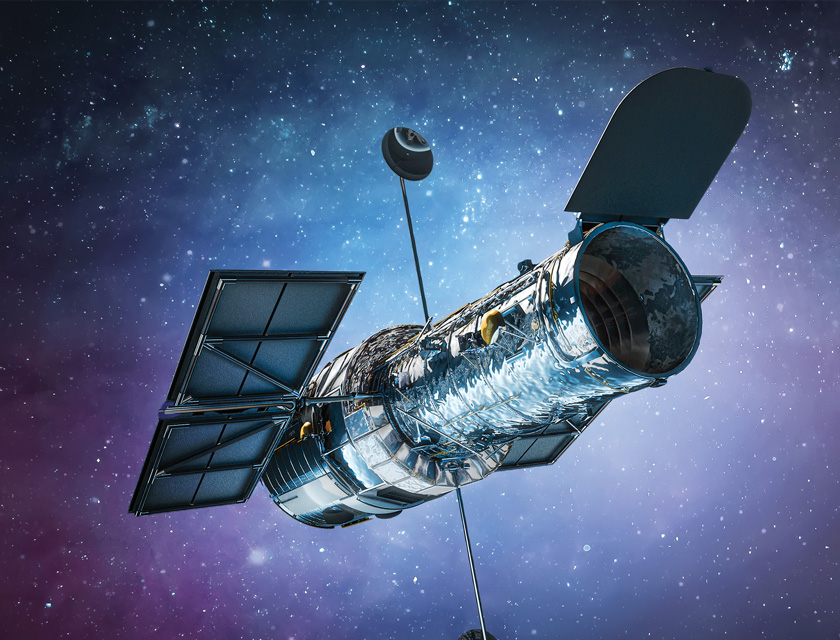
Directly linked to NASA as one of its Great Observatories, the Hubble launched on April 24, 1990, by the crew of the venerable Space Shuttle Discovery (retired in 2011 after 39 missions over 27 years, more than any other spacecraft). Operating in low-Earth orbit (about 300 miles), it observes ultraviolet, visible and near-infrared light to study the universe.
Congress had authorized the creation of the Hubble—named after Edwin Hubble, the most famous U.S. astronomer of the 20th century—in 1977. We’ll spare you too much scientific detail, but according to Britannica, the HST “is a large reflecting telescope whose mirror optics gather light from from celestial objects and direct it into two cameras and two spectrographs (which separate radiation into a spectrum and record the spectrum).”
Astronomy is changed forever by the HST. Among its many observational triumphs: The Hubble Deep Field, a photograph of about 1,500 galaxies, revealed galactic evolution over nearly the entire history of the universe. That’s even longer than Captain Kirk has been alive.
Scratch-resistant lenses
Was it an accident, or was it intentional?
Most sources claim the former. Regardless, NASA scientist Ted Wydeven of the organization’s Ames Research Center was working on a spacecraft water purification system in the 1970s when he coated a filter with a thin, plastic film by using an electric discharge of an organic vapor. The result protected the plastic surfaces of aerospace equipment from scratching.
This film made plastic up to 10 times more scratch resistant than earlier materials. Because scratched-up eyeglasses and sunglasses are dysfunctional and uncool, Foster Grant (you’ll read about FG in this month’s Time Tested story) licensed the technology in 1983 and used it to make scratch-resistant lenses for the masses.
Water filter technology
NASA innovation during the great moon race with Russia included finding a way to keep drinking water pure for long periods, without using heavy chemicals.
NASA’s research program resulted in a small, lightweight water purifier featuring low power usage and minimal maintenance for use in the Apollo spacecraft. The 9-ounce device, slightly larger than a pack of cigarettes and chlorine free, used silver ions to kill bacteria and activated carbon to remove pollutants.
That technology, now available commercially, is still used inside water pitchers and refrigerator filters to remove contaminants.
Super Soaker
We won’t even try to top this lede from Smithsonian magazine:
“You might think it doesn’t take a rocket scientist to invent a squirt gun like the Super Soaker. But Lonnie Johnson, the inventor who devised this hugely popular toy that can drench half the neighborhood with a single pull of the trigger, actually worked on the Galileo and Cassini satellite programs and at NASA’s Jet Propulsion Laboratory, where he helped develop the B2 stealth bomber.”
Johnson, who has more than 120 patents, lay claim to the top-selling toy in the world by 1992—and it was all one big misfire.
He was at home in 1982, trying to make an improved heat pump, when his prototype sprang a leak and a burst of water shot across the room. He remembers thinking, “That would make a great squirt gun.”
In 1986, Johnson was awarded U.S. Patent No. 4,591,071 for a device titled “Squirt Gun.” Hope he hired out for the marketing.