
Typo in the second paragraph below? No. A boardinghouse reach for a pun? Guilty.
We can’t say who invented sunglasses (though some on the internet have tried), because nobody knows. They have evolved over centuries. But we can say with some degree of authority that the thinking behind the first form of sunglasses was Inuitive.
Multiple sources explain how in ancient times, Inuit and Yupik people in the Arctic invented narrowslit snow goggles from materials such as bone, wood and ivory to prevent blindness from the bright glare of the sun on the snow. Rarehistoricalphotos.com says the goggles have been found in Inuit archeological sites up to 2,000 years old.
But eyewear that protects people from something on the ground isn’t exactly the true definition of sunglasses. There’s a notion—not historically verified—that in the early 11th century during the Song Dynasty, Emperor Cheng ordered the creation of eyewear shaped like animals or characters to protect workers’ eyes outdoors.
It also has been written that in 12th-century China, the first tinted-lens sunglasses approximating modern designs had lenses made of smoky quartz. The most interesting aspect of these is that they were purportedly made for judges so their eyes would not give them away during court proceedings.
On the boardwalk, boardwalk
Better to stick to more recent history, which has more reliable documentation. In the mid-1700s, British optician James Ayscough invented sunglasses in the general form we still wear today.
Why? Because jamesayscough.com says so!
Seriously, Ayscough’s family does have a solid claim. He recommended adding green or blue tint to lenses to reduce the amount of light reaching a user’s eyes, and that tint is the hallmark of today’s shades.
The process of making sunglasses is as varied as it is complex. But according to sunglasses maker Rawbare, frames are usually built from either acetate, a rich plant-based plastic; metal, for slimmer profiles; or TR90, a light, flexible nylon. Lenses are cut from materials such as polycarbonate or other optical plastics, then tinted and treated.
In America, sunglasses emerged from the dark less than 100 years ago. Sam Foster sold his first pair of sunglasses on the Atlantic City boardwalk, and the concept of safe eyewear as a fashion accessory quickly caught fire—fueled by the “Who’s That Behind Those Foster Grants?” ad campaign featuring Hollywood stars.
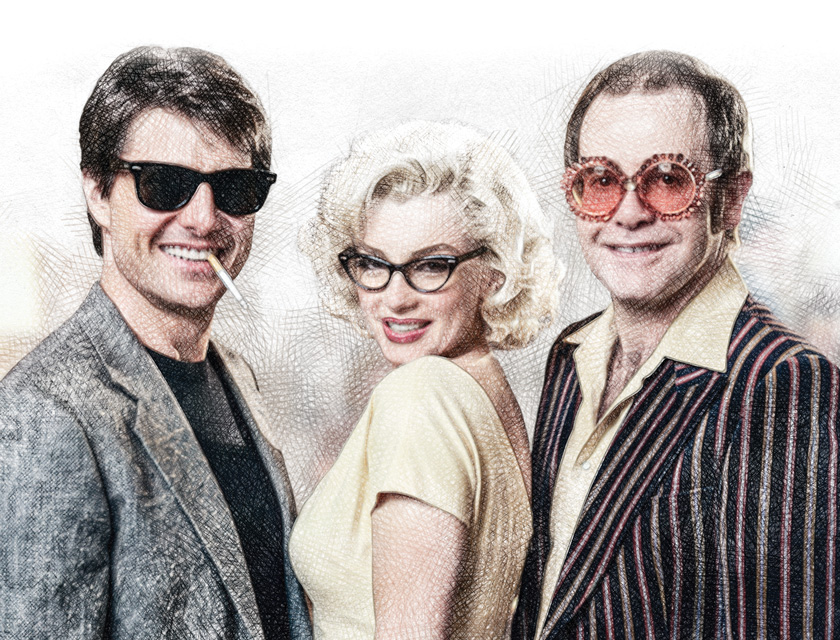
Before long, celebrities were associated with their preferred shades as much as any other part of their wardrobe, as millions in our star-crossed country scrambled to follow suit:
- Marilyn Monroe, Audrey Hepburn and the “cat-eyes” that became ubiquitous for women in the 1950s and ’60s.
- The round, wire-rimmed “granny glasses” popularized by John Lennon in the late 1960s and early ’70s, as well as the little, rectangular shades that became synonymous with the Byrds’ Roger McGuinn.
- A cavalcade of huge, wild, ostentatious sunglasses that became Elton John’s trademark in the 1970s and ’80s.
- Tom Cruise fashion statements in two 1980s sparked runaway sales: the large, black square sunglasses in “Risky Business” (also a hallmark of the Blues Brothers), and his wire-framed aviators in “Top Gun.”
- Rihanna’s single-piece, curved lenses that wrap around the face—shield frames—are a consistent go-to for Gen Z and Generation Alpha.
(Mouqy.com has a fun list of the 10 Most Iconic Sunglasses in Movies.)